I write after eating mochakotta kolambu (lab-lab beans curry) and rasam, from Chennai. It was very well made by S. Even a little of rice is enough to provide a feeling that I do not get with other foods, an over-filled pleasure that is not too harsh, especially when you have it after a monstrous nap. I have found a liking for rice in the past few weeks, my tummy too visibly reflects it. I refrigerate it, and have it with a meal-prepped pot of dal with vegetables, when at home in Bangalore. But I will have to stop having rice, will do.

I have been thinking of what makes my days recently directionless (A few of my previous weekly notes discuss this): what differentiates the salaried employee from somebody who is content (in principle) with what they are doing outside of a employer-employee relationship? I ask this question because the work I do in many forms is something I’d like to continue to do. With Aruvu, with other projects here and there, I see the value in them, but feel a cynicality about the kind of work. This cynicality appears when I struggle to realise the value of the work from the outsider’s perspective. I am currently not a salaried employee. The desire to collect money exists at the same time as a surface-level understanding of the systems of hurt, exploitation, and inequity that this system of collecting money enables. So how do I put myself in a place that allows me to work without the slightly irrational concern of capital always? The concern is irrational because it takes over the conviction and value I see in the work.
The last two years, I worked (continue to) at a place that gave both the collection of the employee’s guarantee: salary, and the fulfilment of doing work I placed value in. Of course the relationship was not binary, and was not so simple. But for now, temporarily, the guarantee is unavailable, there is no salary, and cynicality hardened in this period. What is the value of such work for an individual’s path if capital is always going to be hard to collect? This is of course a privileged individual asking this question, far removed from the crude realities. I have been lucky to have been granted money (NMG 2026), and to be affiliated to institutions and people, and to be supported by parental wealth that has enabled all of this. The cynicality is ever present, across work I have done previously like Safe Yelli and other people’s work that I observe. It is of the relationship between good work, work that is socially oriented, and capital.
The work must happen, it is beyond concerns of capital, that conviction is present. But what gives somebody the confidence that capital will follow? My grandparents made handloom veshtis, and sold it to the village weaving cooperative. They would receive weekly payouts. They tried their hand at business occasionally, but failed largely. My parents turned to salaried professions, and out of the expediency of having to pay back loans, they did not experiment with businesses (my mother only after she felt free of parenting every other minute). Did either generation feel for themselves the conviction to work for something that was not guaranteeing capital? No, atleast as far as I know.

At this point I cannot see myself working for something I do not feel the conviction towards. Perhaps that must change for me to survive in this present system of collecting capital. But if the feeling towards socially meaningful work is the strongest, should I not feel more confident in my conviction? It must be beyond what is salary.
I realised for myself (not newly, but even more strongly) the distinction between an “expectation of work” and “a conviction in values and vision”. I am reading Anand Teltumbde’s “Caste Con Census”, which is a very pragmatic telling of how caste enumeration in the past and present is dually enabling the crystallisation of caste identities and powers and the fight for representation.
Granville Austin is quoted in Anand Teltumbde’s work. He says
the Constituent Assembly was composed not of political theorists or transformative visionaries but of ‘practical men of affairs’ whose class and institutional loyalties profoundly influenced the shape of the Constitution.
The overarching question that Anand Teltumbde is exploring in this section is, Why was caste not pragmatically and directly tackled in the Constituent Assembly (CA)? Ambedkar, the visionary we celebrate today was almost not elected to the CA! Ambedkar did not initially have the support of congress to be offered a seat. He was offered a seat through the Muslim League in the Jessore-Khulna constituency, which went away as part of East Pakistan in the partition. As a result he was disqualified. In the July of 1947, Congress finally enabled his re-election from Poona. Had only “practical men of affairs” been part of the CA, we would live in a very different country today. 1
“I do not understand how you can abolish untouchability without abolishing the very caste system. Untouchability is nothing but the symptom of the disease, namely, the caste system […]’
The vision to abolish caste did not find support in the assembly. When Granville coins something like ‘practical men of affairs’, it hits me that being ‘practical’ comes with an acceptance of all sorts of the status-quo.
Something I have been observing in the leadership of Aruvu and Living Labs (Shreyas, Naveen, Vinay) has been the strength of the vision. It comes from their belief in how things must be. There is a conviction in the vision, the processes and inbetween may be things to learn from and of, but how things must be, is clear in their minds, even though it does not fit so well in this system of capital accumulation.
This is going to churn for some more time in me, How do you believe in good work without the cynicism? How do you maintain the conviction? Aman noticed this in one form, he says I worry about the future of the project/work before actually putting in the work myself to shape it to a good stage. To a stage where people and value will pour in.
I have been hearing the sounds of Reels (Instagram Reels, YouTube Shorts) everywhere: busses, streets, tea shops, parks, yelahanka nodal center, autos, trains, everywhere! The effect of reels on social spaces is too much! It is not just the individual hearing it. I went for a brisk walk to shake off the day one day in Vidyaranyapura. It is one evening when I noticed the lack of reels.

A dear friend, Harsha brings mangoes for all of us from Chitta, Bidar. I forget to keep it in the refrigerator, and it remained the whole night on the center table. In the morning, I woke up and walked to my laptop in my dazy sleep. And I smell the mangoes.

DakkhanKe, Dakkhanke.com a social enterprise in Bidar, anchored by Living Labs, working with Banjara embroiders and Bidri Artisans has launched. There is currently a limited edition collection, ‘Yazdani’s Drawings’ textile art available for purchase. Please visit and go through the website and materials.

I have not had eggs in over 10 years. Nor have I noticed branded eggs in most people’s homes. This time at a shop in Vyalikaval, I notice the various trajectories that have been taken. “Protein enriched”, “no hormones”, “free range”, “antibiotic free”, the most surprising was “veg feed only”, what is vegetarian for a hen? I am reminded of the poultry farms I noticed close to Mallasamudram in Kaveri, Kanmaigal, Karmegam, Kodiyakkarai, where egrets feed on the shit-mountain of the prisoner chickens.


I had to travel to Chennai, and thought I got lucky with a last minute train ticket, just a few hours before departure. I realised as I reach SMVT that the train was post-poned to the next day. IRCTC did not display the updated timings on the app when I was booking and I fell for it. I took an un-reserved ticket on the Guwahati express, having no other choice. What followed was a night of mild adventures, and things I had never done before.

The 2 unreserved coaches at the end were full by the time I reached. I heard a lot of Bengali sounding sentences, and occasionally Hindi. I walked back and forth multiple times to try and find a place to perch my butt. Even if it was small, but It was full, over-full with 4 people sometimes, and 3 sitting on the upper berth. I did not want to ask anybody to give me space within that tiny portion they had already, so I kept roaming, trying to find a seat, but it did not seem possible. I looked strange in the crowd, wearing a bag with a chest and hip strap, and I was travelling alone. Not many seemed to be travelling alone. Eye contact would not follow with a smile.
I told myself the bogey floor was the only realistic possibility for the 6 hour journey. I understood why the toilet-corners of the bogey were not occupied already after noticing the wet floors and smelling the smells. Atleast the corridors were wider than other coaches I thought. But they too could not accommodate me. It would be too many dangling legs.
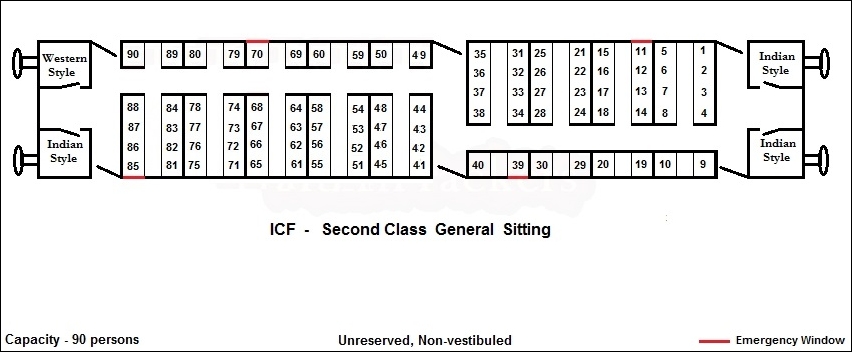
I decided the perfect place was in the alley in the middle of the coach. There would be a lot of people moving about, but atleast it was next to the door and would be ventilated much more. I had 3 people for company through the night. All travelling to Assam. One person working in Soolagiri (near hosur) was telling me about going to see his son’s state level football match and made chit-chat with me about CM Vijay. He was a butcher. There was a painter opposite me who had smartly brought on a sturdy paint-bucket as luggage. It served as a seat for him in the Alley! And with him was a young relative, who was mostly on his phone.
The night was hard to sleep in, there were drunk arguments at 1AM, and peoples’ legs and heads would fall on yours as all of us tried to find a configuration to sleep in that worked.
At 3AM, I and most of the bogey woke up to a TTE asking people to show their tickets. The TTE would force fully wake up passengers by tugging on blankets, shouting at them. ‘Eaaai! Ticket dikhao, ticket dikhao’. It took me a while to realise that there were two TTEs, one would reach the end of the bogey while the other would come from the beginning. I was wondering why, I realised as soon as few travellers started walking away from the TTEs, some were travelling without tickets and one would shout to the other TTE, ‘pudinga sir avana, odra paarunga’. These were tamil-speaking TTEs, I could recognise by the kind of hindi they spoke. They would catch the few without tickets and would alternate between ‘thumara’, and ‘aapka’. ‘Train thumara baap ka kya?’ One TTE in particular was very aggressive, making slapping movements to indicate ‘police mardega’, when people said they did not have the money to pay the fine. The fine was a 1000rs!

Water began flowing down the floor around 340AM. And people on the floor had to be woken up. It dried out in half an hour, and people were back with some cloth on the floor.
After over an hour of drama across the coach, the TTE finally finished, a few were fined, and a few let go after they showed the balance of their bank accounts.

Very few times the TTEs showed respect to the passengers, and to pay a 1000rs fine for a wet floor and seatless journey for many does not make sense to me. Why are there not more unreserved coaches? The state shows no obligation of services towards people who cannot pay high rates, but they have still paid, so where is the respect?
- Akshay reached out after reading my blog last week. He realised a Ghost instance that he was maintaining had also been breached. It is a conversation with him that motivated the length of this blog. Thank you Akshay.
In a world where algorithms are forcing most people to conform, where even the contrarians, nonconformists, and critical commentators are converging on the same format and the same depth and the same predictable commentary; in that world, I think, blogs are the last place remaining for soul searching and for the meta-questions about the world
https://www.constitutionofindia.net/historical-constitution/cabinet-mission-plan-cabinet-mission-1946/↩︎